Journal · 9 min read
Personalized Gifts for Grandparents: Engraved Once, or Personal Every Month
What are the best personalized gifts for grandparents?
Personalized gifts for grandparents divide into two kinds: an object customised once at checkout, and a gift that is personal again every time it arrives. Engraved objects — a name plate, a photo canvas, a star map — stop being personal the moment they are unwrapped, and then stay on a shelf in a house that has usually decided to stop accumulating. A recurring format keeps regenerating instead: FamilyLetter, a monthly printed 4x6 photo postcard from the whole family, starts at $59.99 for three months, billed once per term and renewing at the same price unless you cancel. Before buying either kind, find out whether there is shelf space.
The two kinds of personalized gifts for grandparents
You are not short of options. You have nine tabs open and every one of them will put a name on something.
That is what this whole category sells, and it sells it well. Type the names, upload a photo, choose a date, and personalisation is finished before the box ships. The object arrives already having done the personal part.
Which is fine, unless you have noticed what happened to the last one.
One family we came across has a standing rule about what they send the grandparents: a gift must not need dusting.
Run the search results through that. The engraved cutting board needs dusting. The photo canvas needs dusting. The star map, the monogrammed robe, the wooden puzzle of a family photo — dusting, dusting, a cupboard. It is one line and it eliminates most of a $2.78-a-click keyword in about four seconds.
The rule sounds fussy until you understand what is behind it. People in their seventies are frequently not passively short of space. They have decided to stop accumulating, and a customised object is harder to refuse and harder to re-home than a generic one, because your name is on it.
Buying for a house that has usually decided to stop accumulating is the same problem one generation down, and we cover it separately.
So the useful division is not customised versus generic. It is a gift personalised once versus a gift that is personal again every month. Something that consumes or disposes of itself leaves nothing behind to keep — and that turns out to be a feature, endorsed by the people receiving as often as the people sending.
Four things below survive the rule. One of them barely does, and its conditions are listed.
Four personalized gifts for grandparents worth the money
Better than a commissioned portrait
An in-home photo session with the grandparent in the frame
Book a photographer to come to the house for an ordinary hour — not a studio, not a backdrop, not matching shirts. One family who hired an in-home newborn photographer found afterwards that the pictures they cared about were not the ones of the baby. They were the ones with the grandparent in them, holding her, doing something they already do. That family's next session was planned around the grandparents specifically, doing normal things with the children rather than posing.
- Why it works
- Every other personalised photo gift takes a picture you already own and moves it onto a new surface. This one makes the picture. It also solves the thing nobody says out loud, which is that the grandparents are almost never in the family photographs, because they are usually the ones being visited.
- Skip it if
- Skip it if you will not be in the same room. A session needs someone to arrange the house, meet the photographer and keep the afternoon calm, and that person cannot be you from three states away. Skip it too if the grandparent has spent forty years avoiding cameras. Booking a stranger to photograph someone who dislikes being photographed is not a gift, it is an appointment.
Pricing varies by photographer and market. We did not verify a national figure and will not invent one.
If you will not be in the same room, the distance is the real constraint rather than the occasion, and we keep a separate list of keeping a distant grandparent in the loop.
Someone else's product, and a good one
A recipe in their own handwriting, on something the family uses
Someone took their grandfather's peanut-brittle recipe, in his handwriting, and had it etched onto a trivet. It landed harder than anything else that year. The handwriting is the gift — the slant of it, the crossings-out, the fact that his hand made those marks — and the recipe is only the excuse to reproduce it. This is not our product and we do not make anything like it; go to a maker who does.
- Why it works
- It passes the dusting rule on a technicality, and the technicality is the point: a trivet lives in a kitchen drawer and comes out when something hot needs putting down. It is used, not displayed. Handwriting is also the one thing about a person that cannot be bought in a shop, which is why this works on recipients who genuinely need nothing.
- Skip it if
- Skip it if there is no surviving sample. A recipe typed out from memory is not handwriting, and a scan of a card someone else wrote is a small lie you will have to stand next to while it is opened. Skip it too if the handwriting belongs to someone who has died and the family has not agreed about it. Turning a dead parent's hand into a decorative object is a decision for the whole family, not a surprise for one of them.
Plum Print, which makes custom recipe books from handwritten cards, states that pricing varies with the number of recipes and keepsakes included and publishes no starting figure (plumprint.com, checked 2026-09-15). Engraved trivets and boards are widely made to order; pricing varies by maker and material.
Personalised, and gone by December
A photo calendar that empties itself over the year
A photo-a-day or photo-a-month calendar is the rare customised object with an expiry date built into it. It is personal for twelve months, it does its job on a wall or a counter, and then the year ends and it goes in the recycling with nobody having to decide anything. Recurring gifts that consume or dispose of themselves came up again and again from both sides — flower subscriptions praised specifically because the flowers can be thrown out, grocery deliveries, food.
- Why it works
- It is the only thing on this list that gets less present over time, which in a downsized house is the correct direction. It also survives the question every other item on this page fails: what happens to it in three years.
- Skip it if
- Skip it if the wall is already full, because it will be leaned against something and never hung. And do not assume it gets used just because it is useful. One family noticed their in-laws' guest bathroom had run out of soap, bought the exact brand and scent that had been there, gave it — and it was never put out. Useful things get saved too.
Pricing varies by size, format and page count. Plum Print's own roundup lists a brass easel calendar starting at $59, but that figure is theirs and we could not confirm it on the maker's site on 2026-09-15, so it does not travel.
Three conditions, all of them required
A digital photo frame, if all three are true
The evidence on these looks contradictory until you sort it by household. On threads about new grandparents they are loved without a single dissenting voice, named by brand, praised by the grandparents themselves. On a thread about a seventy-two-year-old with no new grandchild, four separate people reported frames that went unused — one sold at a yard sale, one returned, one household where both sets of parents own one and neither uses it, and the seventy-two-year-old saying plainly that she does not use hers.
- Why it works
- The variable is not whether people keep sending photos. It is whether a photo-producing event exists at all. A new baby generates a constant supply and a motivated sender; grown grandchildren generate neither, and the frame becomes another thing to dust.
- Skip it if
- Skip it if there is no new baby. Skip it if you will not physically be in the room to set it up — the one clear success in the sceptical thread is the one where the family configured it for her, and a competing guide currently sells these with the line “no tech-savvy grandparent required,” which is not what the owners report. Skip it if they already own one, which is likelier than you think.
Aura's frames run $149 for the Carver 10", $179 for the Carver Mat, $229 for the Aspen 12", $299 for the Walden 15" and $499 for the Aura Ink 13" (auraframes.com, checked 2026-09-15).
Every one of those figures was read off Aura's own site on the date shown.
The thing this SERP sells most, and you should buy least
Framed prints.
Almost every result above this one closes on custom framing, and it is the weakest idea on the page. Older recipients typically already have many photographs and many frames. Asked directly, people in that age group said the better move is to enclose a photo with a card and not make the frame the main gift.
That is worth sitting with, because it inverts the usual instinct. The photo is welcome. The frame is the part that has to go somewhere.
Where FamilyLetter fits, and where it doesn't
We publish this guide and we sell one of the things on it, which is why it is not in the list above. Four ranked slots, none of them ours.
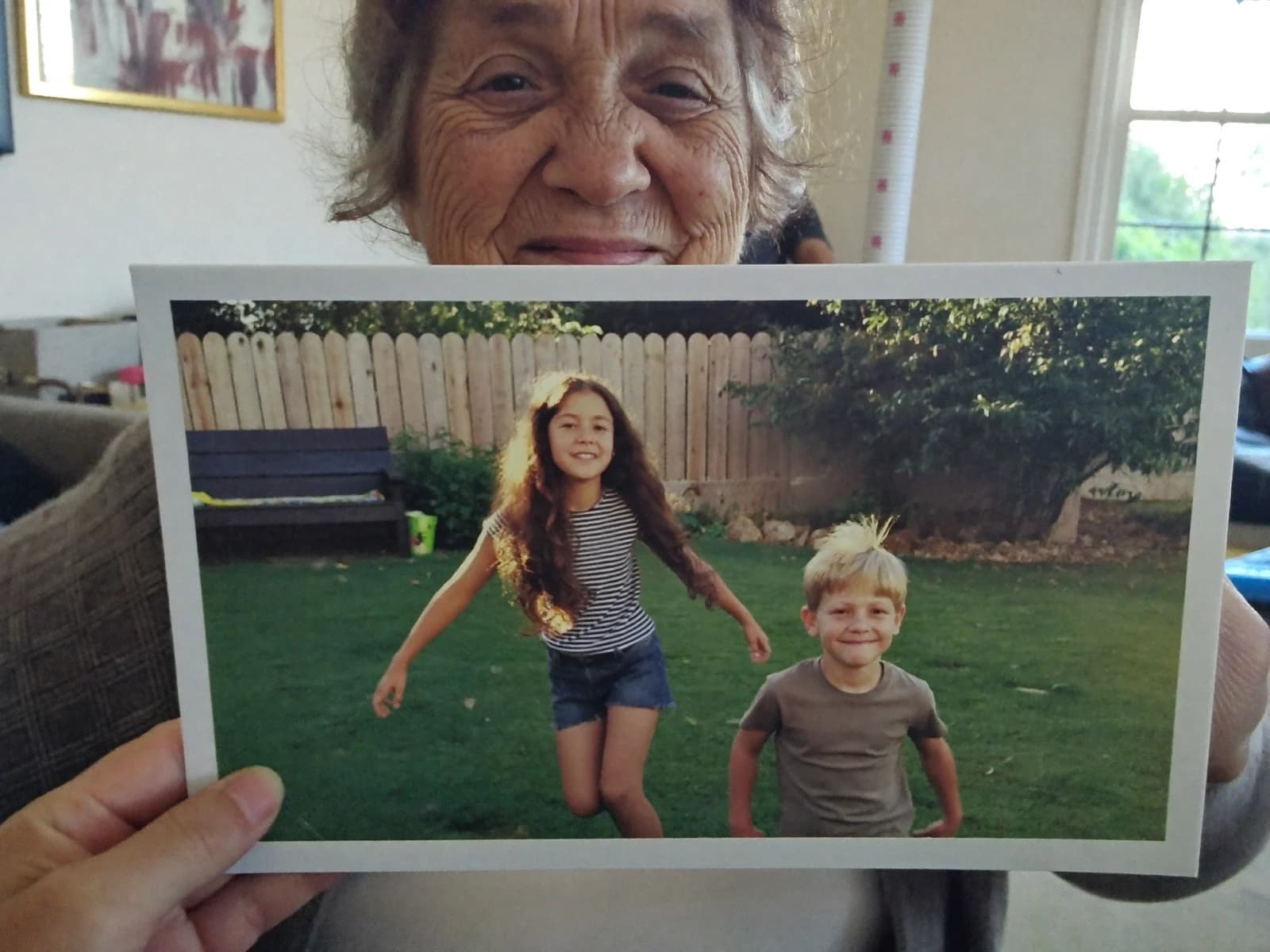
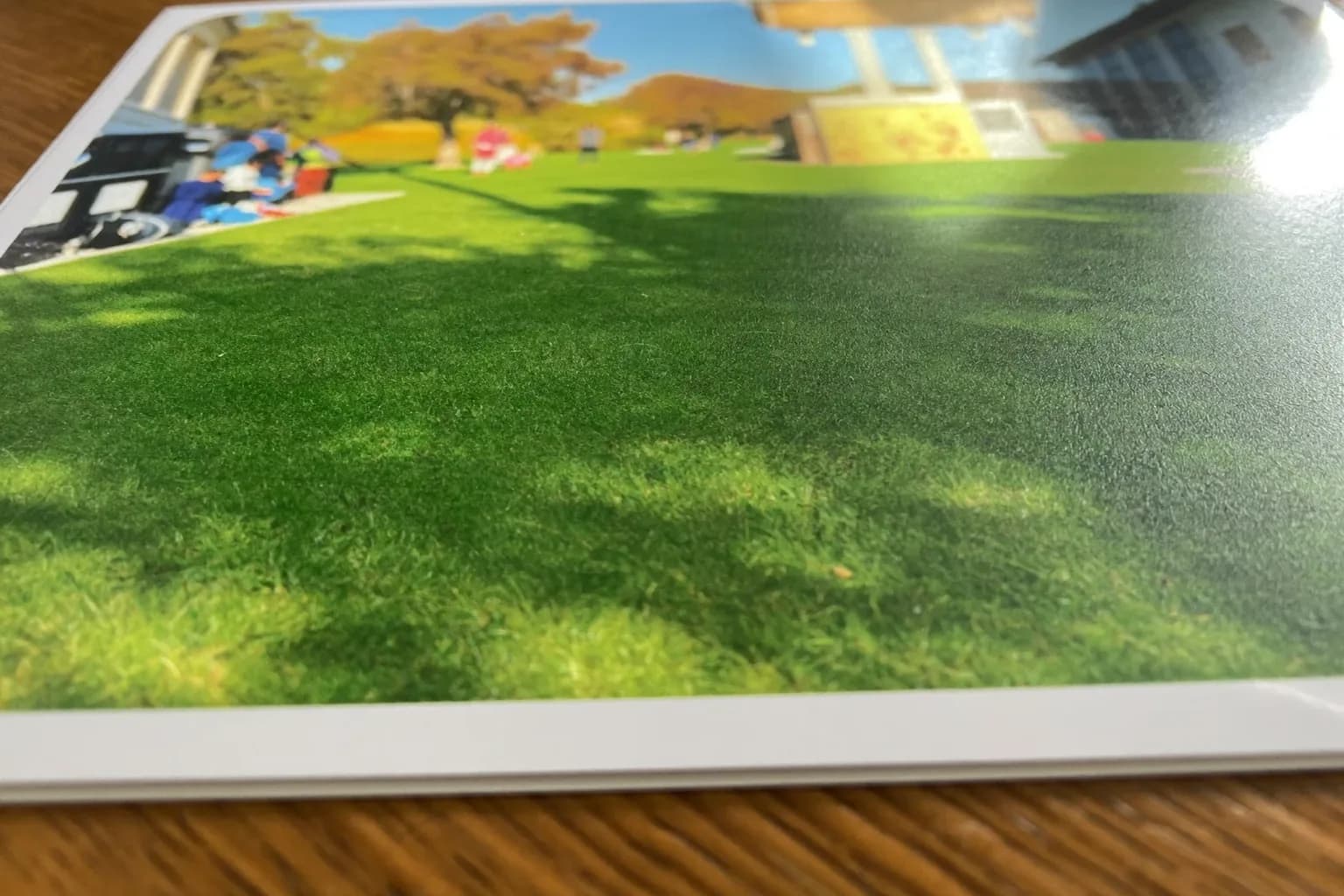
FamilyLetter sits in the second half of the argument — the every-month half. A family group gets one text prompt a month, up to five contributors send a photo and a few lines, and one printed 4x6 photo postcard goes to each recipient household with first-class printing and postage included. Contributors choose a handwriting style from over twenty fonts; the card is set in that style, and to be exact about it, we do not reproduce anyone's real handwriting. Nothing prints until you approve it. You can skip any recipient for that month's card. Grandparents at one address are one household and share one card at no extra charge.
It goes on the fridge. Later it comes off the fridge and goes in the bin, and nothing has to be dusted in between.
Three months is $59.99, six months is $89.99 and twelve months is $139.99 — $19.99, $14.99 and $11.66 a month respectively, billed once for the term and renewing at the same price unless you cancel. Additional recipient households are +$5, +$6 or +$10 per term, up to four.
We are the wrong gift for you in three cases. If there is exactly one recipient and nobody else in the family will contribute, you are paying for a group mechanic you are not using. If your family will not reliably answer a monthly text, the card gets thinner every month and you will feel it. And if the grandparent has said she does not want more post, believe her. That is the same rule as the dusting one, and it applies to us.
If none of those three is you, start your first postcard and see what comes back.
The grandmother-by-grandmother list is the faster route if you are buying for her alone.
Frequently asked questions
- What are good personalized gifts for grandparents?
- The ones that survive contact with a downsized house. An in-home photo session with the grandparent actually in the pictures, a family recipe reproduced in the original handwriting on something that gets used, a calendar that is finished by December, and — only if there is a new baby and you will be there to set it up — a digital frame. Everything else on a typical results page is an object that has to be found a home.
- What are some cool presents I can give my grandparents?
- Anything that arrives more than once. A single customised object is personal at the moment of unwrapping and then it is furniture; a recurring gift is personal again each time it turns up. Flower subscriptions, food deliveries and monthly printed cards all work on that principle, and they share the thing that makes them safe: they leave nothing behind that has to be kept.
- What to gift grandparents who have everything?
- Stop looking for an object and start looking for a rule. One family's is that a gift must not need dusting. Whatever the rule in your family is, it is usually already known and rarely written down, and asking for it is less awkward than another year of guessing. “They have everything” is your description of the situation. It is not theirs — theirs is closer to “we are trying to get rid of things.”
- What is the 5 gift rule for adults?
- It is a budgeting convention — something they want, something they need, something to wear, something to read, plus one extra — and it exists to cap spending on children at Christmas. It does not transfer well here. The problem with buying for grandparents is almost never how many gifts to buy; it is that four of the five categories produce objects, and objects are the constraint. Our research on this recipient covers what gets kept and what gets stored. It says nothing about counting to five, and we are not going to pretend otherwise.